
Loading...

Designing a better conference attendee experience starts with better data. At MPI World Education Congress this year, we did something most conference sessions don’t do. We strapped heart-rate monitors on the attendees.
The research question was as follows: if we change the facilitation technique, the content structure, or the environment in real time, can we actually see the physiological response? Can we watch engagement happen — or disappear — in the data?
The answer was yes. And what we saw should change how any of us think about experience design.
For decades, the standard measure of event success has been the post-event survey. Attendees rate their experience on a 1–5 scale, write a few comments, and move on. The data goes into a report. The report goes into a folder.
The problem isn’t that surveys are useless. It’s that they measure memory, not experience, and only capture the perspective of whoever chooses to complete one. By the time someone fills out a survey, they’ve already filtered and reframed what they felt. The moments of genuine engagement — the split second when a room goes quiet because something landed, the physical alertness of being genuinely curious — those don’t survive the gap between experience and reflection.
Neurologic feedback doesn’t have that problem. It captures the moment itself.
“The moments of genuine engagement don’t survive the gap between experience and reflection. Neurologic feedback captures the moment itself.”
During our session Experiences with Heart at MPI WEC, Courtney Stanley and I led attendees through a live experiment. Participants wore heart-rate monitors throughout the session as we deliberately shifted facilitation techniques, content structures, and environmental conditions — and watched the data change in real time.
A few things we tested:
The results were immediate and visible. And in several cases, they contradicted what conventional event design wisdom would predict.
 📷
📷
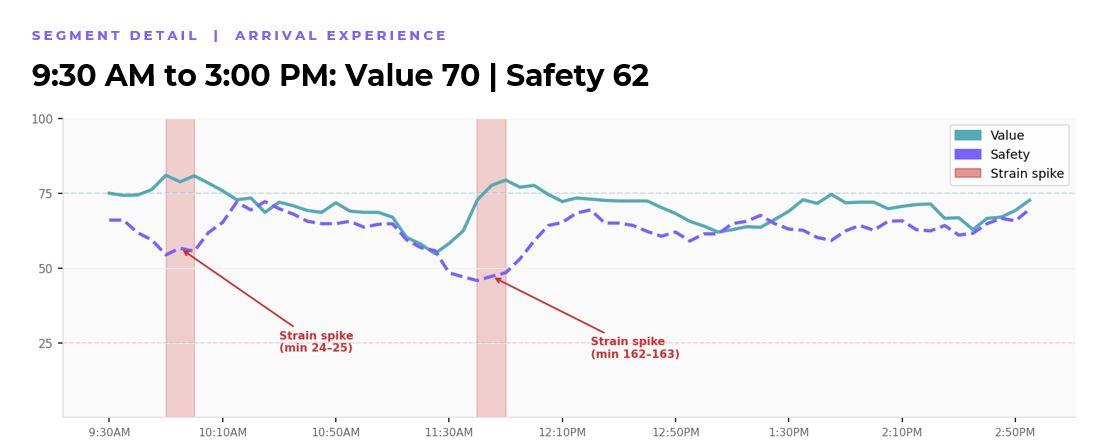
Neurologic data captured in real time during MPI WEC — tracking attendee engagement across a session segment throughout the day.
When we shifted from presenter-led content to peer-to-peer interaction, heart rates increased almost immediately. But the spike was short. Within two to three minutes, rates normalized — and in some cases dropped below baseline. The implication: activation is easy. Sustained engagement is the design challenge.
When Courtney shared a personal story about a formative experience, heart rate variability across the room stabilized and elevated — and stayed there longer than any framework or model we introduced. Story isn’t decoration. It’s architecture.
The sharpest drops in engagement didn’t happen during content — they happened in the white space between segments. The moment the presenter paused to advance a slide, to transition topics, to ask if there were questions. Those micro-transitions, left undesigned, are where attention goes to die.
You don’t need to outfit your entire audience with heart-rate monitors to apply these principles. What the data gives us is a framework for designing a stronger attendee experience — focused on where attention is most at risk: :
This is the kind of thinking that separates events people remember from events people forget. And it’s the experience design framework we bring to every experience Ansera produces.
Want the full session resources, frameworks, and data from Experiences with Heart at MPI WEC?
→ Download the MPI Session Resources
EJ Corporan is Director of Marketing & Research at Ansera, where he leads experience strategy, thought leadership, and the Science of Awe research platform.


