Loading...

- About
- Exhibit
- Attend
- What's on
- Help
- Exhibitor Directory
- Show more

A packed room is not a proof of engagement. Audiences today tend to be overstimulated, distracted, and mentally elsewhere.
The audience engagement examples worth studying share one quality: they were designed around a specific psychological truth rather than the size of the stage. The difference is intention — specifically, the intention to design for awe.
UC Berkeley professor Dacher Keltner has spent decades researching awe across 26 countries. His findings hold across cultures: awe stretches our perception of time, sharpens memory, deepens emotion, and opens people to new ideas. It’s also measurable. 49% of event professionals say engagement drives ROI more than any other single factor.
The examples below each illustrate what intentional design looks like in practice — and why it works on a human level.
The Opening That Resets the Room
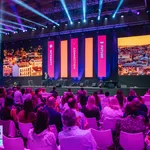
A custom intro video hits the screen before a word is spoken. Three large projection screens, hanging LED displays, and lighted panels pulse together — the theme graphics building into a three-dimensional environment that surrounds the room. By the time the first presenter walks out, the audience is already inside the story.
Most general sessions open identically: a moderator walks out, welcomes the crowd, and moves into housekeeping. Within sixty seconds, the audience has sized up the next several hours. That judgment is hard to reverse.
A choreographed opening that resets expectation does something neurologically distinct. Research published in Psychological Science found that awe pulls people fully into the present moment and stretches their perception of time. Design that triggers that response is the foundation of done well —live event production through coordinated sound, light, and deliberate pacing — earns presence before a single agenda item begins. And presence, once established in the first two minutes, holds.
Nearly 7,000 attendees. A massive convention center. Synchronized wearable and stage lighting moves through the crowd in waves, while motion graphics and broadcast-level production transform the space. What could have felt like an arena becomes, in the words of the production team, “surprising intimacy.” Every person in the room feels part of a single, unified moment.
Scale creates distance. In large venues, the back half of the audience often experiences a mediated version of the event rather than the event itself. Wearable lighting closes that gap by turning the audience into part of the production.
Keltner’s research identifies collective movement — what sociologist Émile Durkheim called “collective effervescence” — as one of eight universal sources of awe. Moving together, lighting up together, responding together: these moments generate a felt sense of connection to something larger than the individual. Technology enables it. But without the design intention, it’s just light.
Immersive Brand Activations Built Around a Journey
A salesforce walks into a venue expecting a product expo. Instead, a continuous scenic ribbon links the general session to the expo floor — dramatic entry features, dynamic wayfinding, interactive learning stations led by faculty and industry experts. The general session and the expo flow together as one experience.
When spatial layout, scenic fabrication, and interactive elements are built around an emotional arc, attendees slow down. They explore. The brand stops being something they see and becomes something they move through.
A logo on a backdrop asks for nothing. An environment with texture, sequence, and designed discovery asks people to be curious — and curiosity, once triggered, sustains itself. It’s the same logic behind every brand event worth remembering.
Same content. Same slides. The presenter has been coached on where to stand, when to pause, how to use the full width of the stage. The audience that was leaning back is now leaning forward.
Stage blocking changes the audience’s relationship to the content before a word is spoken. When a presenter knows where to stand, when to pause, and how to use the full width of a stage, the message carries differently. In one production, deliberate blocking of a 56-member cast brought clarity and cohesion to every moment on stage. The audience didn’t notice the blocking. They noticed they couldn’t look away.
A conference theme lives beyond the stage through a custom intro video, animated stage content, and event creative that carries the visual story through every touchpoint: entrance truss, window and wall clings, wayfinding columns. The emotional arc of the day starts before the doors open and follows attendees out.
The Journal of Personality and Social Psychology has found that awe makes experiences more emotionally intense and more memorable. Video production done with that in mind — opening sequences, sizzle reels, closing recaps — preserves the emotional peak of a live moment and gives it reach.
This is one of the most underleveraged audience engagement examples in corporate events. The emotional moment already happened. Production that captures it well turns a single-day experience into something that resonates for weeks.
More than 1,000 people joining a flagship hybrid event online, alongside nearly 7,000 in the room. The production brief: make the virtual audience feel like participants, not viewers. Broadcast-level production, synchronized moments designed for both audiences, and a program built around connection rather than transmission.
Remote attendees default to observer mode because most hybrid events are designed for the room first and the screen as an afterthought. Build timed engagement moments for both audiences simultaneously, acknowledge the virtual room directly, design visual environments that read on a screen — and participation follows. Presence is a design decision. Distance is what happens when you skip it.
A gimmick generates a reaction. Strong examples generate a response — attention, emotion, and a memory that holds. The test: does the moment serve the content, or distract from it?
Keltner’s research found that even one or two minutes of genuine awe produces measurable effects on connection and memory. Intention is the variable that matters most.
Start with what’s observable: sustained attention, physical response, social sharing, and post-event conversation. Longer term, message recall and behavioral follow-through are the truest signals that engagement created real impact.
Participation is action. Engagement is the quality of presence behind it. A room in rapt silence can be more engaged than one answering polls.
Ansera builds experiences grounded in the science of awe — from the first cue to the final moment. General sessions, brand activations, hybrid events, video production: we work across every discipline that shapes how an audience feels, connects, and remembers.
Dig Deeper
The Impact of Lighting and Sound on Event Atmosphere
10 Activation Ideas to Make Your Event Memorable
4 Tips to Make Your Hybrid Event More Engaging